Thermal Imaging for Solar PV Inspection
As Solar PV installations continue to grow, ensuring the long-term performance of photovoltaic (PV) systems has become more important than ever. While solar panels are designed to operate for decades, issues such as hotspots, cracked cells, faulty bypass diodes, loose electrical connections and damaged connectors can silently increase the risk of failure.
This is where “Thermal Imaging” plays a crucial role in Solar PV inspection
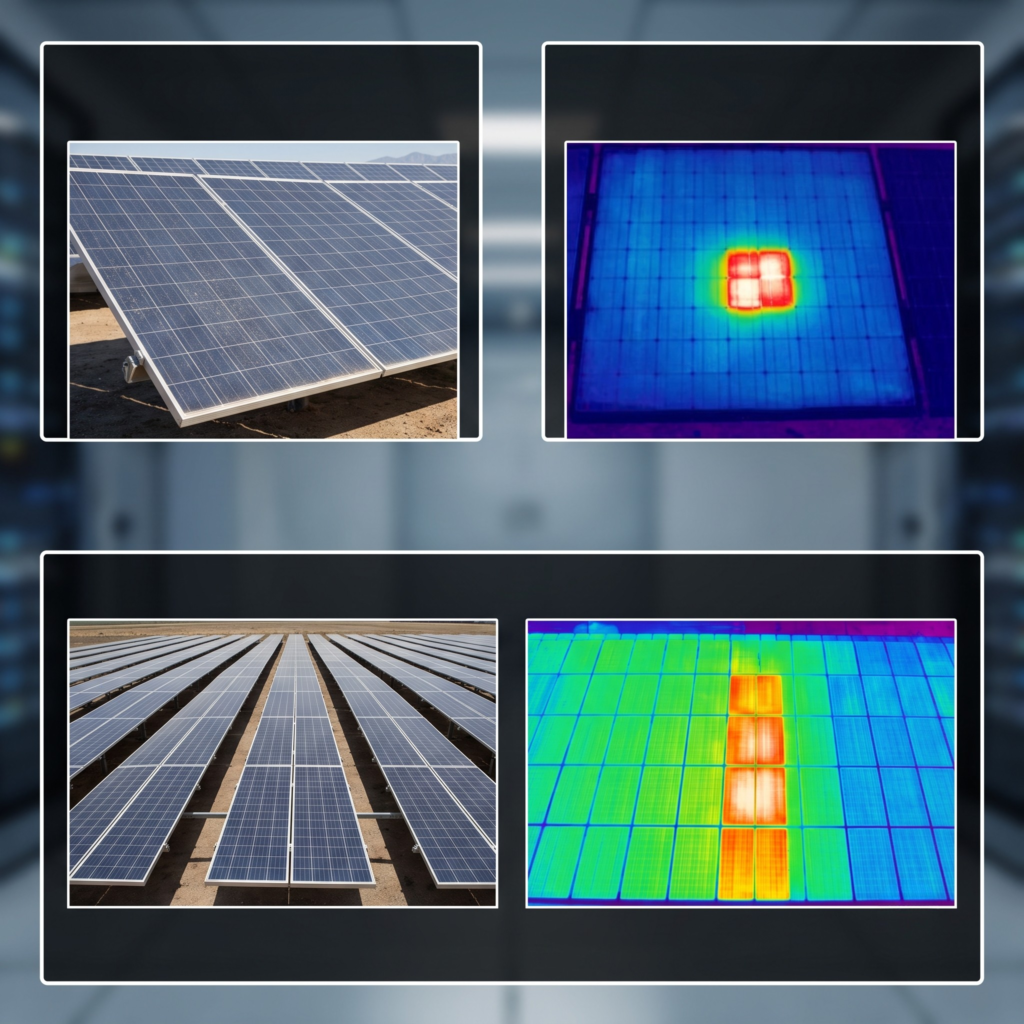
A thermal imager allows maintenance teams to quickly identify abnormal temperature patterns across PV modules without interrupting system operation.
Hotspots that are invisible to the naked eye appear clearly in thermal images, enabling engineers to detect developing faults before they lead to energy losses or costly downtime.
Regular thermal inspections help improve preventive maintenance by identifying underperforming panels, verifying installation quality and prioritizing repairs based on actual thermal conditions.
For utility-scale solar plants, commercial rooftops and industrial facilities, this means better energy yield, reduced maintenance costs and extended asset life.
To achieve accurate results, inspections should be performed under suitable weather conditions and with proper camera settings such as emissivity and temperature range. It is also important to inspect the rear side of PV modules when required, as reflective surfaces on the front can affect thermal measurements.
Thermal imaging is no longer just a troubleshooting tool—it has become an essential part of modern solar asset management. By detecting problems early, plant operators can maximize system efficiency, minimize unexpected failures, and protect their investment throughout the lifecycle of the solar installation.
What Problems can Thermal Imaging Detect in Solar Panels
Thermal imaging is used in solar PV systems to detect temperature anomalies that indicate underlying electrical or material defects. In photovoltaic modules, issues such as cell micro-cracks, solder bond degradation, PID (Potential Induced Degradation) and high-resistance connections lead to localized resistive heating. These defects are not visible in standard visual inspections but manifest as abnormal heat signatures due to increased I²R losses. By analyzing infrared radiation patterns, engineers can identify hotspots, string imbalances and bypass diode failures at an early stage. This prevents progressive degradation, energy yield loss and potential fire hazards in large-scale solar installations.
How Thermal Imaging is done in Solar Panels
Thermal inspection of solar PV systems is typically performed using calibrated infrared cameras under stable irradiance conditions, ideally above 600 W/m² to ensure accurate thermal contrast. The inspection is conducted either from ground level, elevated platforms, or using drones for utility-scale plants. The thermal imager is configured with correct emissivity settings and reflected temperature compensation to improve measurement accuracy. Engineers scan modules in a systematic grid pattern, capturing thermograms of each string and module. The collected thermal data is then analyzed to identify temperature differentials between cells, with deviations of 5–10°C or more often indicating potential faults requiring further electrical testing or module replacement.
Ultimately, seeing beyond the visible spectrum allows engineers to protect both performance and investment by making thermal imaging an essential tool in modern solar asset management.
Find the best product for your application